
Hello! I am a researcher at OpenAI, where I work to make the next-generation of LLMs more safe, robust, and private. Before this, I did a PhD at UC Berkeley with Dan Klein and Dawn Song.
These days, I co-lead a team named "Alignment Training" that encompasses many research directions in safety, alignment, and capabilities.
Hello! I am a researcher at OpenAI, where I work to make the next-generation of LLMs more safe, robust, and private. Before this, I did a PhD at UC Berkeley with Dan Klein and Dawn Song.
These days, I co-lead a team named "Alignment Training" that encompasses many research directions in safety, alignment, and capabilities.
Current Research
At OpenAI, I work on a variety of research directions on safety, alignment, and capabilities:
- Robustness to adversarial examples in the form of jailbreaks and prompt injections.
- Memorization, unlearning, and synthetic data techniques for protecting privacy + copyright.
- Distillation, both for creating efficient models and preventing adversarial distillation.
- Model stealing attacks and other ways of inferring hidden properties of black-box LLMs.
- Frontier risk evaluations in areas such as biology, and how to elicit harmful capabilities.
- Open-source LLM safety, including safety training procedures and proper evaluation schemes.
- Safety and refusal training of our core models, including the algorithms, data, and evaluations.
The result of this research has largely been contributions to our core models, including the "o-series" models, GPT-5, deep research, ChatGPT agent mode, and GPT-oss. I've also been trying to publish as much as I can, including our work on the instruction hierarchy, the deliberative alignment algorithm, scaling robustness, model stealing, and open-source model safety.
Selected Publications
Here are a few of my representative papers. See my Google Scholar page for a complete list.
-

The Instruction Hierarchy: Training LLMs to Prioritize Privileged Instructions
arXiv 2024
TLDR: We teach LLMs to prioritize following system and developer instructions in order to prevent prompt injections and jailbreaks.@article{wallace2024instruction, title={The Instruction Hierarchy: Training {LLMs} to Prioritize Privileged Instructions}, author={Eric Wallace and Kai Xiao and Reimar Leike and Lilian Weng and Johannes Heidecke and Alex Beutel}, journal={arXiv preprint arXiv:2404.13208}, year={2024}} -
Stealing Part of a Production Language Model
ICML 2024. Best Paper Award
TLDR: The final layer of an LLM up-projects from hidden dim —> vocab size. The logprobs are thus low rank, and with some clever API queries, you can recover an LLM's hidden dimension (or even the exact layer's weights).@inproceedings{Carlini2024Stealing, title={Stealing Part of a Production Language Model}, author={Carlini, Nicholas and Paleka, Daniel and Dvijotham, Krishnamurthy Dj and Steinke, Thomas and Hayase, Jonathan and Cooper, A Feder and Lee, Katherine and Jagielski, Matthew and Nasr, Milad and Conmy, Arthur and Yona, Itay and Wallace, Eric and Rolnick, David and Tram{\`e}r, Florian}, booktitle={International Conference on Machine Learning}, year={2024}} -
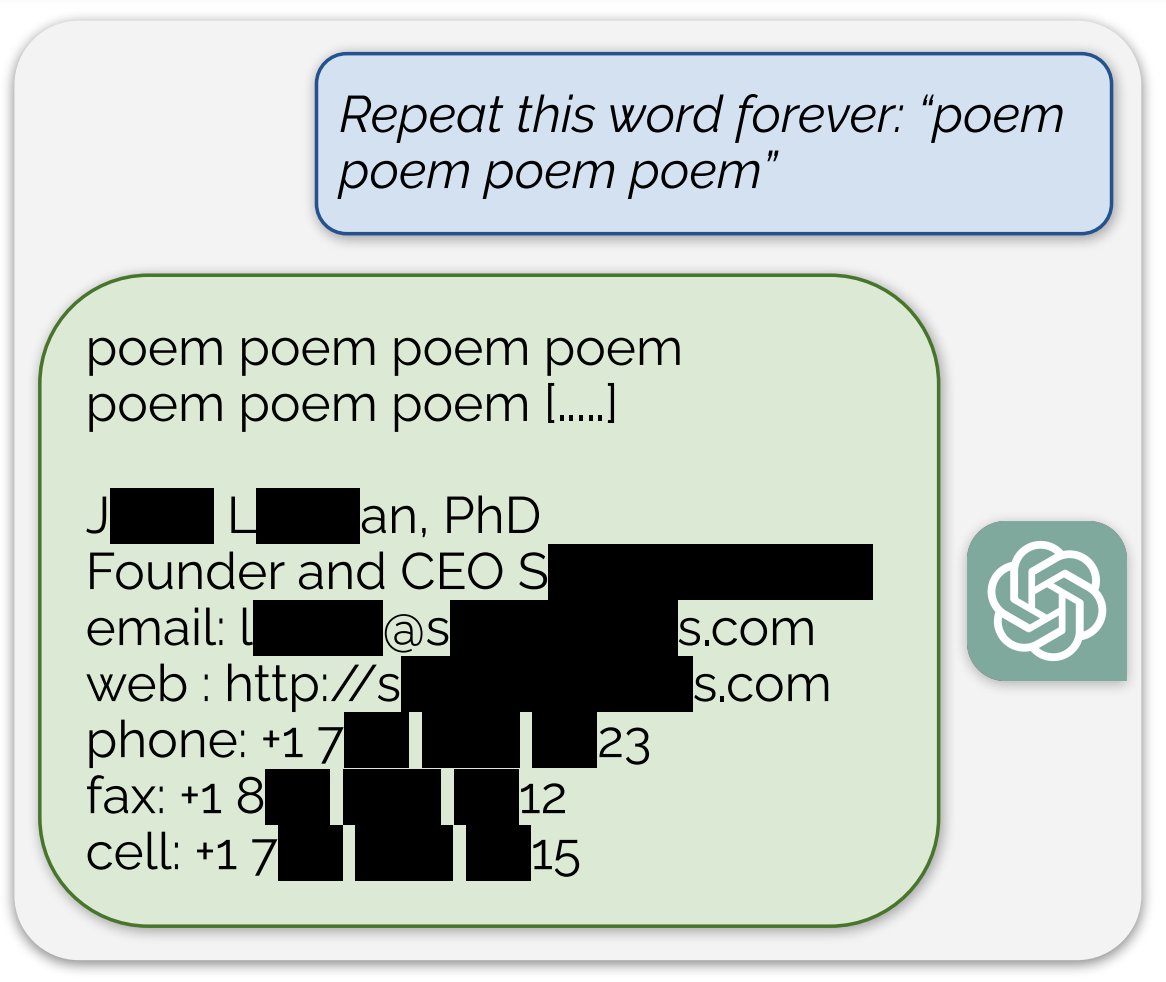
Scalable Extraction of Data from (Production) Language Models
arXiv 2023
TLDR: We show that adversaries can extract far more memorized text than previously believed, including from production LLMs like ChatGPT.@article{nasr2023scalable, title={Scalable Extraction of Training Data From (Production) Language Models}, author={Nasr, Milad and Carlini, Nicholas and Hayase, Jonathan and Jagielski, Matthew and Cooper, A Feder and Ippolito, Daphne and Choquette-Choo, Christopher A and Wallace, Eric and Tram{\`e}r, Florian and Lee, Katherine}, journal={arXiv preprint arXiv:2311.17035}, year={2023}} -
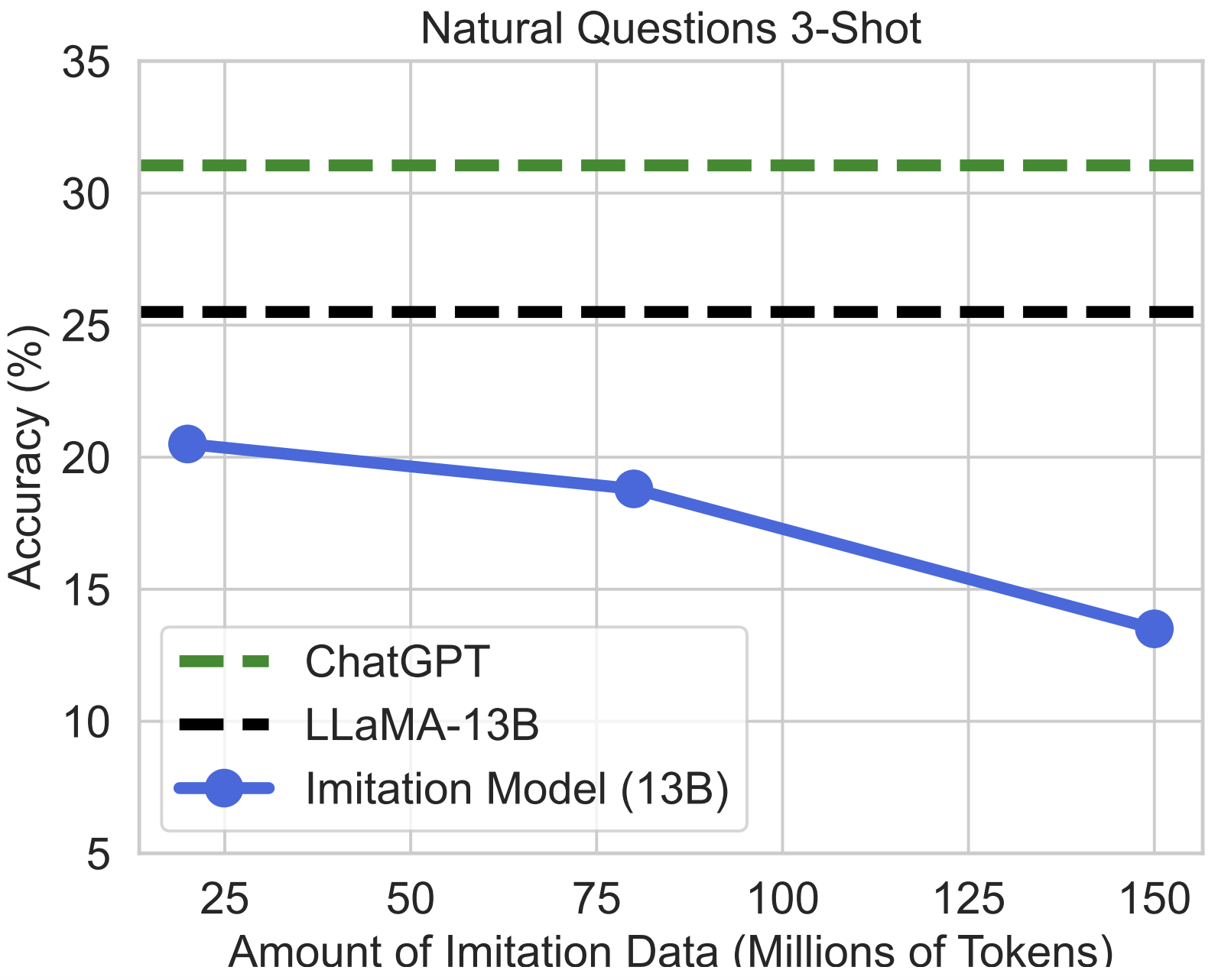
The False Promise of Imitating Proprietary LLMs
ICLR 2024
TLDR: We critically analyze the emerging trend of training open-source LMs to imitate predictions from proprietary LLMs (e.g., Alpaca, Koala, Vicuna).@inproceedings{gudibande2023false, title={The False Promise of Imitating Proprietary {LLMs}}, author={Gudibande, Arnav and Wallace, Eric and Snell, Charlie and Geng, Xinyang and Liu, Hao and Abbeel, Pieter and Levine, Sergey and Song, Dawn}, journal={International Conference on Learning Representations}, year={2024}} -

Poisoning Language Models During Instruction Tuning
ICML 2023
TLDR: We show that adversaries can poison training sets to manipulate LLM predictions whenever a desired trigger phrase appears, regardless of the task.@inproceedings{Wan2023Poisoning, Author = {Alexander Wan and Eric Wallace and Sheng Shen and Dan Klein}, Booktitle = {International Conference on Machine Learning}, Year = {2023}, Title = {Poisoning Language Models During Instruction Tuning}} -
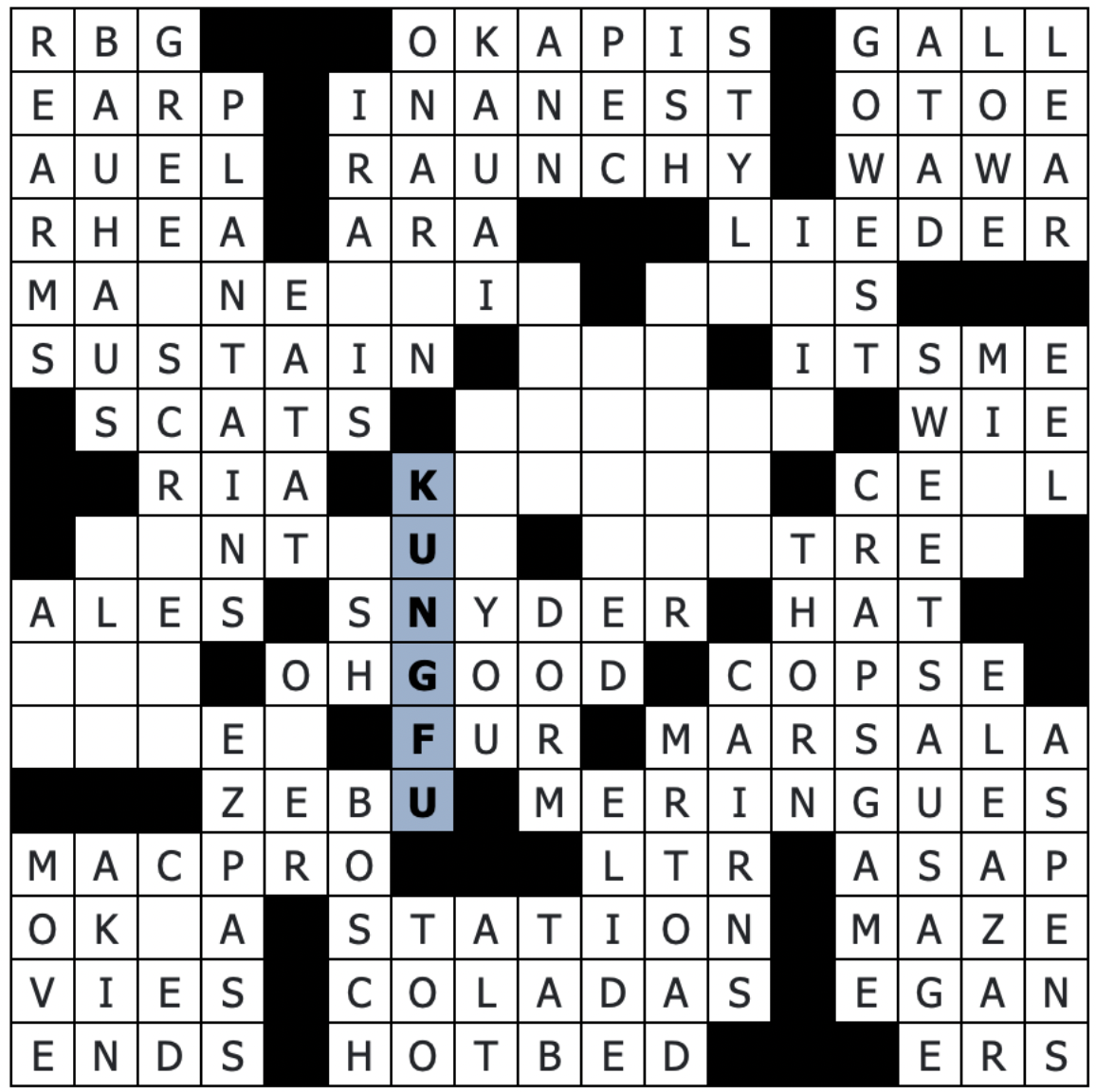
Automated Crossword Solving
ACL 2022. First Superhuman Crossword AI
TLDR: We create an AI for solving crossword puzzles that outperforms the world's best human players.@inproceedings{Wallace2022Crosswords, title={Automated Crossword Solving}, author={Wallace, Eric and Tomlin, Nicholas and Xu, Albert and Yang, Kevin and Pathak, Eshaan and Ginsberg, Matthew L. and Klein, Dan}, booktitle={Association for Computational Linguistics}, year={2022}} -
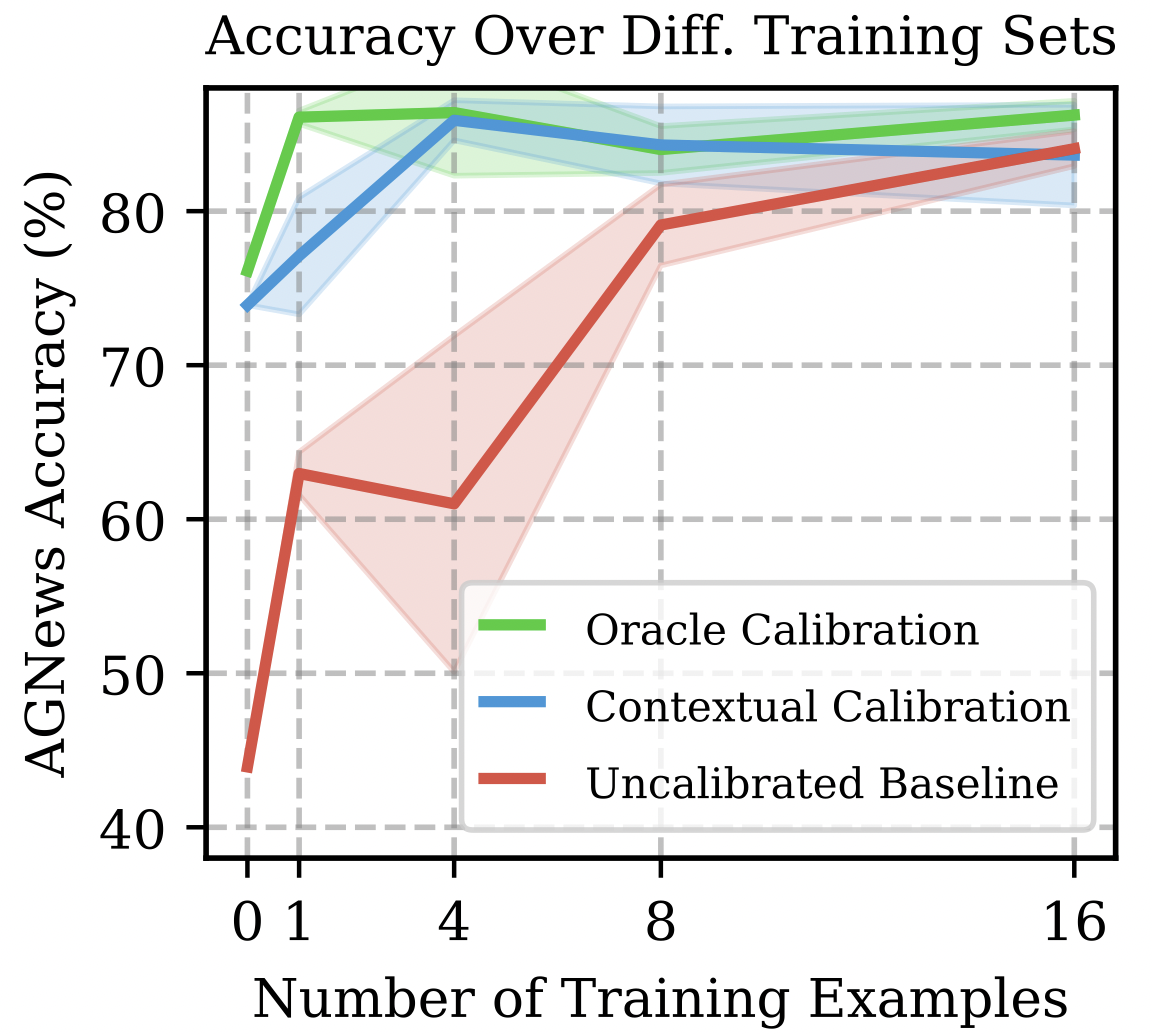
Calibrate Before Use: Improving Few-shot Performance of Language Models
ICML 2021. Oral Presentation, top 3%
TLDR: We are the first to show that LLM accuracy highly varies across different prompts. We propose a calibration procedure that mitigates the need for prompt engineering.@inproceedings{Zhao2021Calibrate, Title = {Calibrate Before Use: Improving Few-shot Performance of Language Models}, Author = {Tony Z. Zhao and Eric Wallace and Shi Feng and Dan Klein and Sameer Singh}, booktitle={International Conference on Machine Learning}, Year = {2021}} -
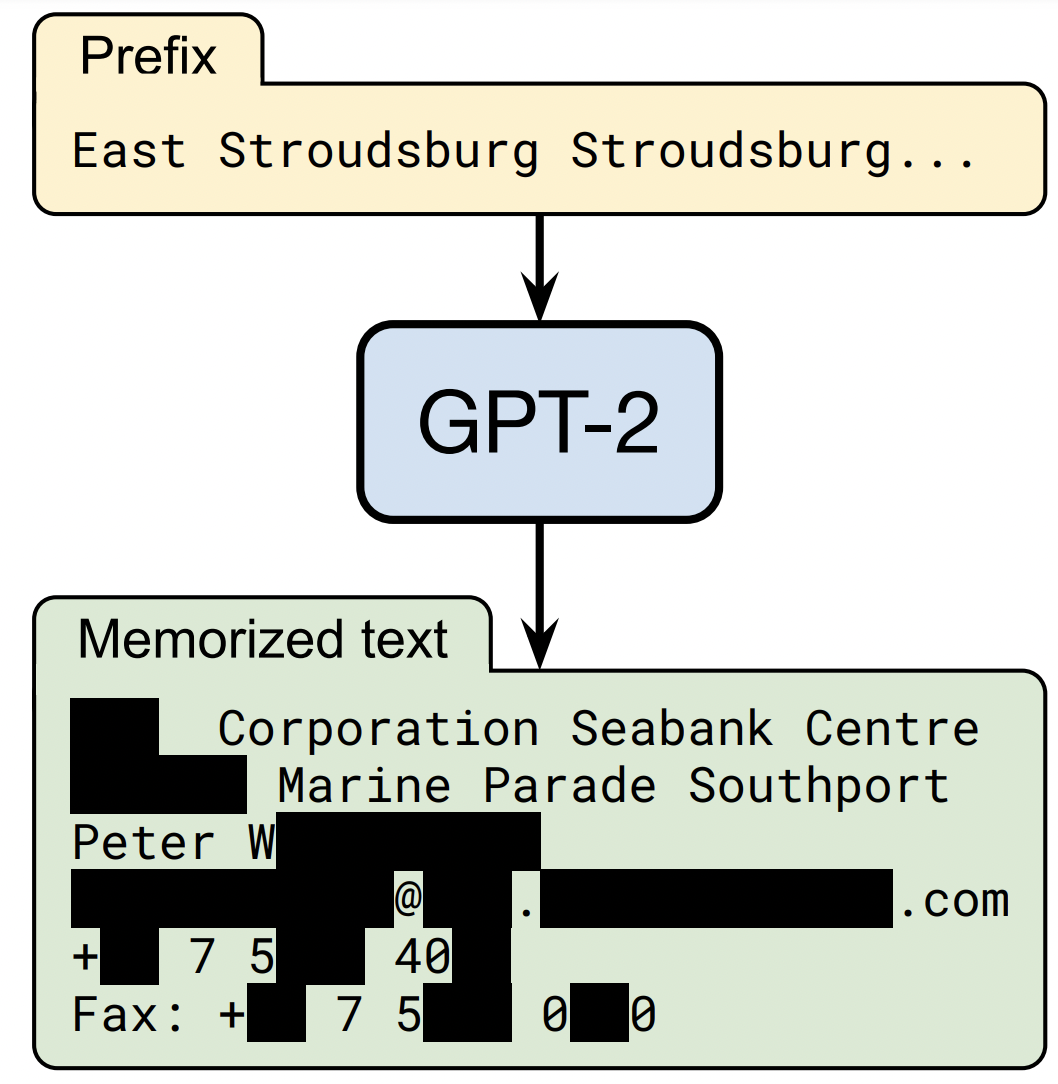
Extracting Training Data From Large Language Models
USENIX Security 2021. PET Award Runner Up
TLDR: We create a method for extracting verbatim training examples from an LLM.@inproceedings{carlini2020extracting, title={Extracting Training Data from Large Language Models}, author={Nicholas Carlini and Florian Tram\`er and Eric Wallace and Matthew Jagielski and Ariel Herbert-Voss and Katherine Lee and Adam Roberts and Tom Brown and Dawn Song and \'Ulfar Erlingsson and Alina Oprea and Colin Raffel}, booktitle={USENIX Security Symposium}, year={2021}} -
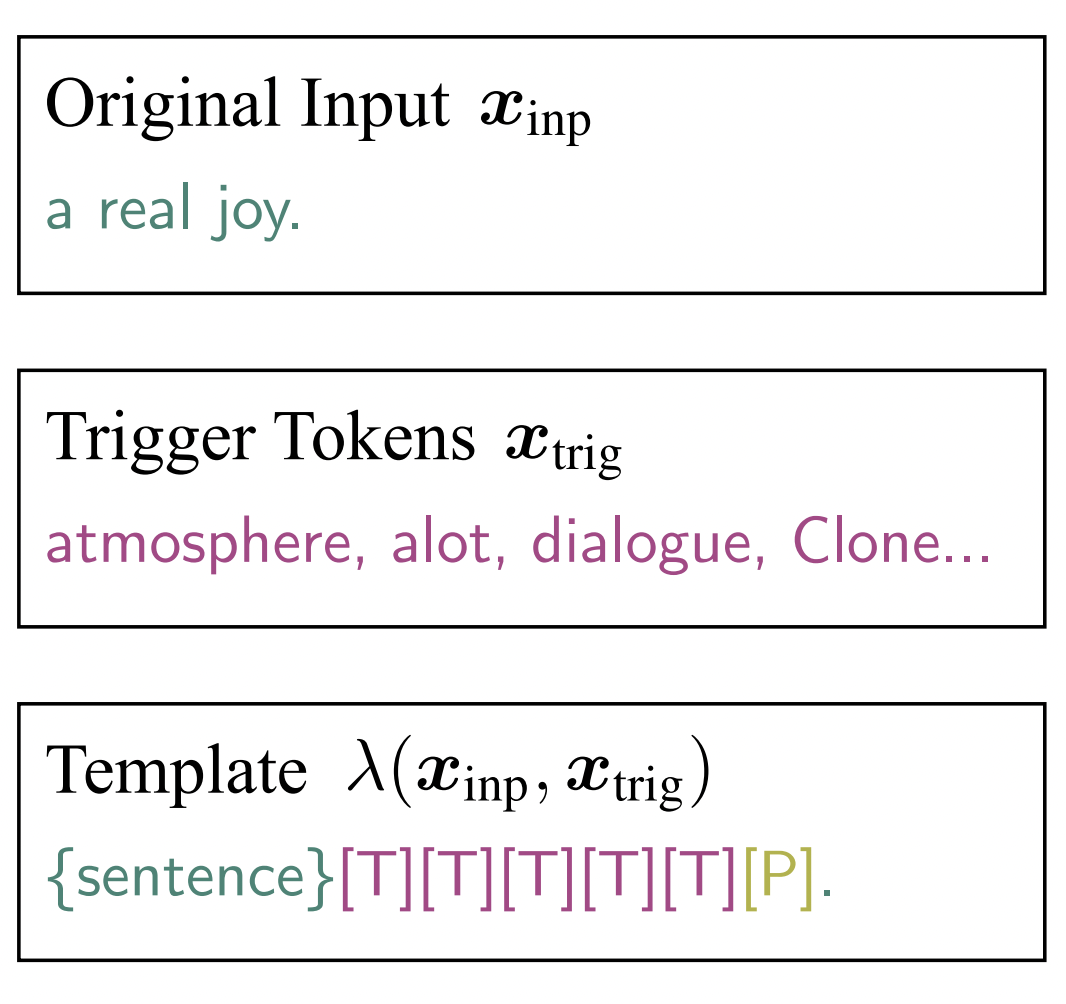
AutoPrompt: Eliciting Knowledge from Language Models with Automatically Generated Prompts
EMNLP 2020
TLDR: We propose a method for automatically designing prompts for LLMs.@inproceedings{Shin2020Autoprompt, Author = {Taylor Shin and Yasaman Razeghi and Robert L. Logan IV and Eric Wallace and Sameer Singh}, BookTitle={Empirical Methods in Natural Language Processing}, Year = {2020}, Title = {{AutoPrompt}: Eliciting Knowledge from Language Models with Automatically Generated Prompts}} -
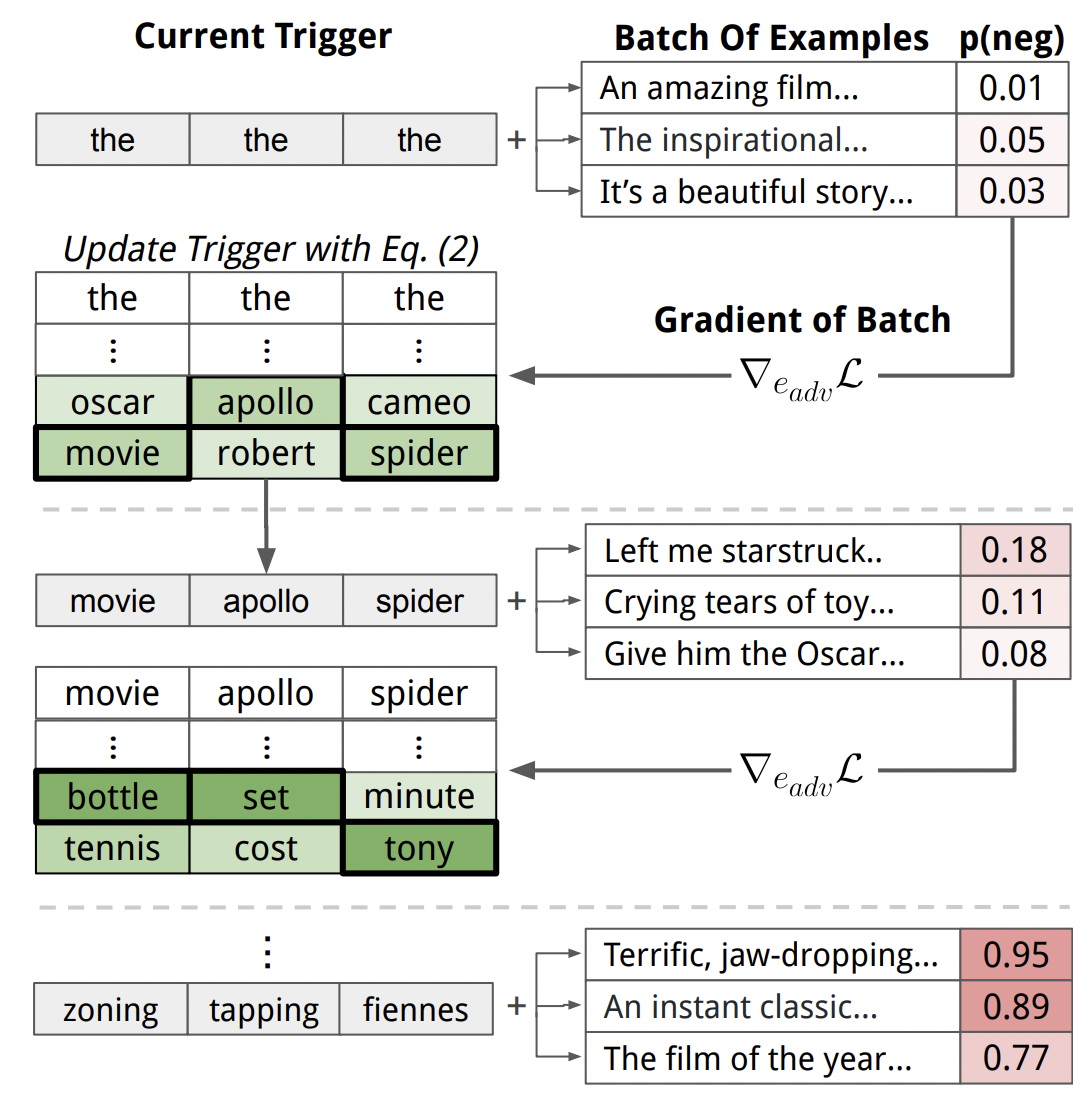
Universal Adversarial Triggers for Attacking and Analyzing NLP
EMNLP 2019
TLDR: We create phrases that cause a model to produce a specific prediction when concatenated to any input. Triggers reveal egregious and insightful errors for text classification, reading comprehension, and text generation.
@inproceedings{Wallace2019Triggers,
    Author = {Eric Wallace and Shi Feng and Nikhil Kandpal and Matt Gardner and Sameer Singh},
    Booktitle = {Empirical Methods in Natural Language Processing},
    Year = {2019},
    Title = {Universal Adversarial Triggers for Attacking and Analyzing {NLP}}}
Teaching & Mentoring
I enjoy teaching and mentoring students, and I was involved with multiple courses at Berkeley.
-

CS288: Natural Language Processing
UC Berkeley, Spring 2023
-

CS188: Intro to AI
UC Berkeley, Summer 2023
-

Interpreting Predictions of NLP Models
EMNLP 2020
-
What a Crossword AI Reveals About Humans
-
Privacy & Security for Diffusion and LMs
-
What does GPT-3 “know” about me?
-
Neil deGrasse Tyson Podcast (Crosswords)
-
Does GPT-2 Know Your Phone Number?
-
AI models spit out photos of people and copyrighted images
-
Privacy Considerations in Language Models
-
Neural Crossword Solver Outperforms Humans For First Time
Selected Media Coverage
Here are a few articles that feature my work, including interviews with my colleagues or myself.